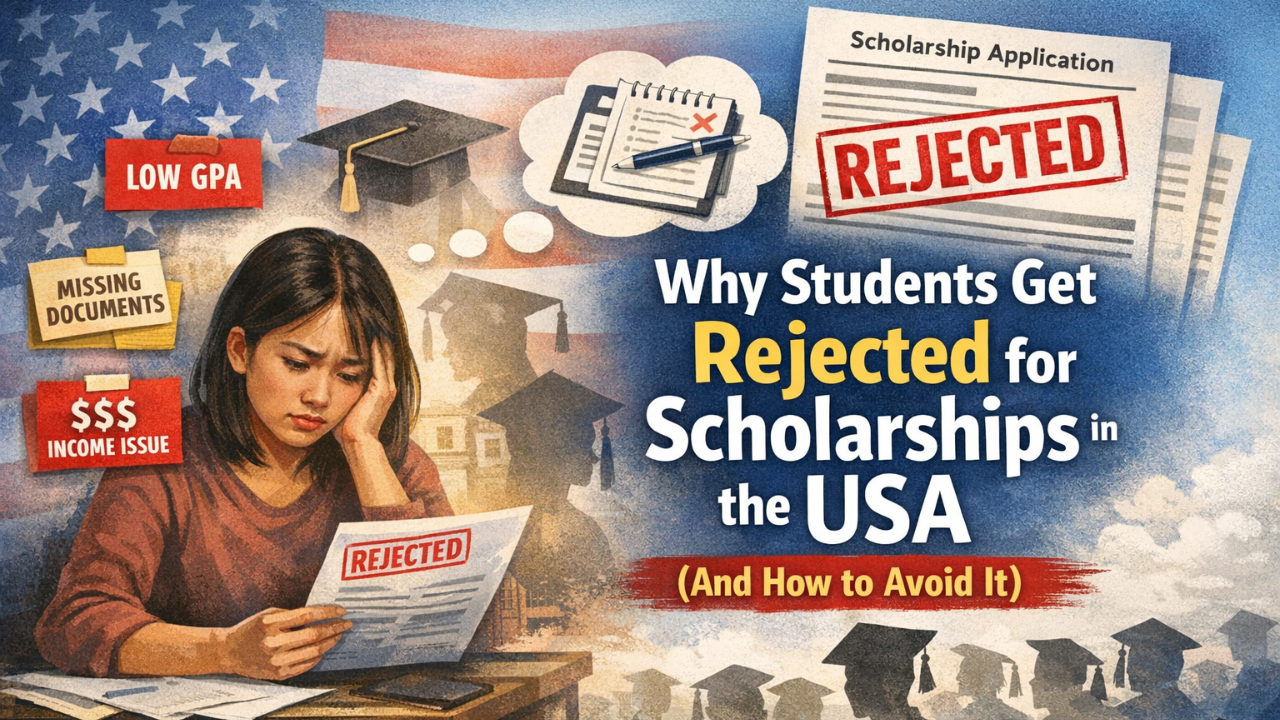
Every year, millions of students apply for scholarships in the United States to reduce the cost of their education. Even though many applicants meet all the basic eligibility requirements, a large number of them still face rejection. This can feel disappointing, confusing, and discouraging—especially when you believe you did everything right.
However, the truth is that scholarship rejection in the USA is very common. It does not necessarily mean that you are unqualified or not good enough. In most cases, rejections happen because of small but important mistakes that students often overlook without realizing it.
If you understand these common reasons in advance, your chances of success in future applications can improve significantly. That’s why this guide explains the most common reasons students are rejected for scholarships in the USA—and, more importantly, how you can avoid these mistakes.
Lack of Eligibility (The Most Common Reason)
One of the biggest reasons scholarship applications are rejected is simple: the applicant does not fully meet the eligibility criteria. Many students skim through eligibility requirements and assume they qualify. However, US scholarships often have very specific conditions related to:
- GPA requirements
- Citizenship or residency status
- Field of study
- Enrollment type (full-time or part-time)
- Academic level (high school senior, undergraduate, graduate)
Income or Financial Information Does Not Match
Many scholarships in the USA are need-based. This means financial information plays a major role in the selection process. Students often get rejected because:
- Reported income does not match official records
- Required financial documents are missing
- Family income exceeds the scholarship’s limit
In some cases, students unintentionally provide incorrect information, which raises red flags during verification.
How to avoid this:
Always provide accurate and complete financial details. If the scholarship requires tax documents or FAFSA-related information, make sure everything is consistent and up to date.
Weak or Generic Personal Statement
The personal statement or essay is where many applications fail.
Scholarship committees in the USA read thousands of essays, and generic answers are easy to spot. Common mistakes include:
- Reusing the same essay for multiple scholarships
- Writing vague goals without personal examples
- Focusing too much on financial problems instead of achievements and motivation
Missing Documents or Late Submission
Many students get rejected for reasons unrelated to merit. Missing documents are a major cause, such as:
- Recommendation letters not submitted on time
- Transcripts missing or uploaded incorrectly
- Incomplete application forms
Applying Without Strategy
Some students believe applying to as many scholarships as possible increases their chances. In reality, random applications often reduce success.
Applying to scholarships that don’t match your background, major, or goals leads to rejection and wasted effort.
How to avoid this:
Focus on quality over quantity. Applying to 5–10 well-matched scholarships with strong applications is far better than submitting dozens of generic ones.
Strong Competition (Even When You Do Everything Right)
In many cases, rejection is not your fault.
US scholarships are extremely competitive. Some programs receive thousands of applications for only a limited number of awards. Even highly qualified students may be rejected simply due to limited funding.
Important to remember:
Rejection does not mean you are not capable or deserving.
How to Avoid Scholarship Rejection (Key Tips)
Here are practical steps that can improve your chances:
- Apply only if you fully meet eligibility requirements
- Customize your essay for each scholarship
- Double-check all documents before submission
- Request recommendation letters early
- Keep deadlines and time zones in mind
What to Do If You Get Rejected
If your application is rejected, don’t give up. Many successful students were rejected multiple times before winning scholarships.
After rejection:
- Review your application honestly
- Improve weak areas such as essays or academics
- Look for local, college-specific, or smaller scholarships
- Apply again in the next cycle
Final Thoughts
Scholarship rejection in the USA is common, but it is also avoidable in many cases. Most rejections happen due to eligibility issues, weak essays, missing documents, or simple mistakes—not because students lack potential.
By understanding how the system works and preparing carefully, you can significantly improve your chances. Treat each application as a learning experience, and remember that one rejection does not define your future.
Homepage Our Website – Click Here